- Understanding the Meaning of Deterrence: An In-Depth Guide
- The Basic Concept of Deterrence
- Key Elements of Deterrence
- Types of Deterrence
- Deterrence in Criminal Justice
- Deterrence in International Relations
- The Economics of Deterrence
- Common Mistakes in Implementing Deterrence
- Evaluating the Effectiveness of Deterrence
- Price of Deterrence in Different Sectors
- FAQs on Deterrence
- What is deterrence in psychology?
- How does deterrence theory work?
- Which factors affect deterrence effectiveness?
- Is deterrence effective in reducing crime?
- Why is nuclear deterrence controversial?
Understanding the Meaning of Deterrence: An In-Depth Guide
Deterrence is a complex yet intriguing concept that has significant implications for various fields, from international relations to criminal justice. In its essence, deterrence refers to the act of preventing or controlling actions or behavior through fear of punishment or consequences. This article aims to provide an extensive exploration of deterrence, its different forms, and how it operates across multiple domains.
The Basic Concept of Deterrence
Deterrence is based on the idea that individuals or entities can be dissuaded from engaging in undesirable actions if they perceive the potential costs or consequences to outweigh the benefits. It’s a strategy employed in diverse areas such as politics, law, and psychology, aiming to reduce occurrences of harmful behavior by instilling fear of repercussions.
Key Elements of Deterrence
For deterrence to be effective, it generally relies on three core components:
- Severity: The punishment must be severe enough to outweigh the benefits of the undesired behavior.
- Certainty: There must be a high probability that punishment will indeed follow the undesired action.
- Celerity: The punishment should be swift, minimizing the time between the action and its consequences.
Types of Deterrence
Deterrence can be categorized into several types based on the context and nature of the deterrent. Here are some variations:
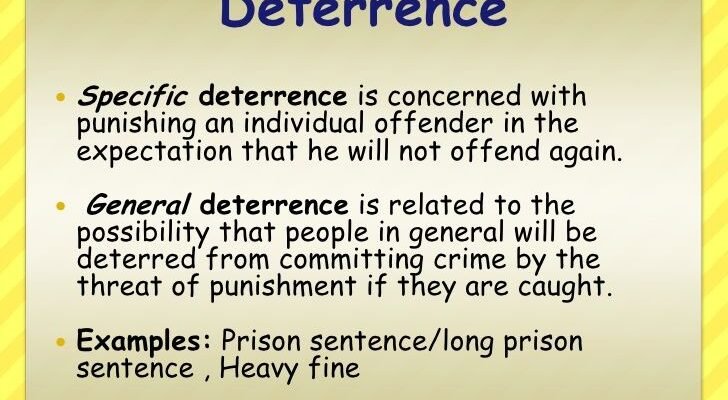
- General Deterrence: Aimed at deterring the public at large from engaging in criminal acts by setting an example with the punishment of individual offenders.
- Specific Deterrence: Targets a particular individual to prevent them from committing further offenses.
- Nuclear Deterrence: In international relations, it refers to the prevention of nuclear conflict through the promise of retaliatory nuclear strikes.
- Ecological Deterrence: Efforts to prevent environmental degradation by imposing fines and punishments for non-compliance with regulations.
Deterrence in Criminal Justice
In the field of criminal justice, deterrence plays a critical role. Legal systems employ both general and specific deterrence to minimize crime rates. By creating a legal framework that stipulates clear consequences for illegal activities, societies aim to maintain order and safety.
Deterrence in International Relations
Deterrence holds substantial importance in international relations, particularly in the context of maintaining global peace and security. Countries leverage military and economic deterrence to dissuade adversaries from aggressive actions. The Cold War era is a well-documented example of nuclear deterrence where both superpowers strategically navigated to avoid mutually assured destruction.
The Economics of Deterrence
From an economic perspective, deterrence can also involve financial penalties and incentives. Businesses may face fines that deter regulatory violations or offer bonuses to encourage compliance. Effective deterrence in this sphere relies on clear rules coupled with transparent enforcement mechanisms.
Common Mistakes in Implementing Deterrence
Despite its potential, the application of deterrence can be flawed. Common mistakes include overestimating punishment severity, underestimating the importance of certainty, and failing to deliver swift consequences. These errors can undermine the effectiveness of deterrent measures.
Evaluating the Effectiveness of Deterrence
Researchers and policymakers often conduct studies to assess deterrence effectiveness. Evidence from statistical data, case studies, and historical analysis is utilized to refine strategies and improve outcomes. Measurements often include changes in crime rates, compliance levels, and behavioral shifts.
Price of Deterrence in Different Sectors
| Sector | Typical Deterrence Measures | Associated Costs |
|---|---|---|
| Criminal Justice | Fines, Imprisonment | Operating prisons, judicial expenses |
| Business Regulations | Fines, Sanctions | Regulatory enforcement, inspections |
| International Relations | Military Readiness | Defense spending, diplomatic efforts |
FAQs on Deterrence
What is deterrence in psychology?
In psychology, deterrence refers to discouraging an individual from engaging in a behavior by making them aware of the negative consequences associated with that behavior.
How does deterrence theory work?
Deterrence theory operates on the principle that potential offenders will abstain from committing crimes if they perceive the risks of punishment as certain, severe, and swift enough to outweigh the benefits of their actions.
Which factors affect deterrence effectiveness?
Factors affecting deterrence effectiveness include the severity of punishment, the likelihood of apprehension, the immediacy of punishment, public awareness, and individual differences in risk perception and rationality.
Is deterrence effective in reducing crime?
Deterrence can be effective in reducing crime, particularly when the elements of certainty, severity, and swiftness of punishment are optimized in conjunction with public education and other preventative measures.
Why is nuclear deterrence controversial?
Nuclear deterrence is controversial due to its reliance on the threat of massive destruction, ethical considerations, and the risks of escalation or accidental launches, sparking debates about its role in global security.







