- Gravity: What Is It and How Does It Work?
- What Is Gravity?
- The Mechanism of Gravity: How Does It Work?
- The Historical Discovery of Gravity
- Applications of Gravity in Technology
- The Role of Gravity in the Universe
- Modern Research in Gravitational Physics
- Common Misconceptions About Gravity
- FAQ Section
- What causes gravity?
- How does gravity affect time?
- Is it possible to create artificial gravity?
- Why are we drawn to Earth and not floating in space?
- What are gravitational waves?
Gravity: What Is It and How Does It Work?
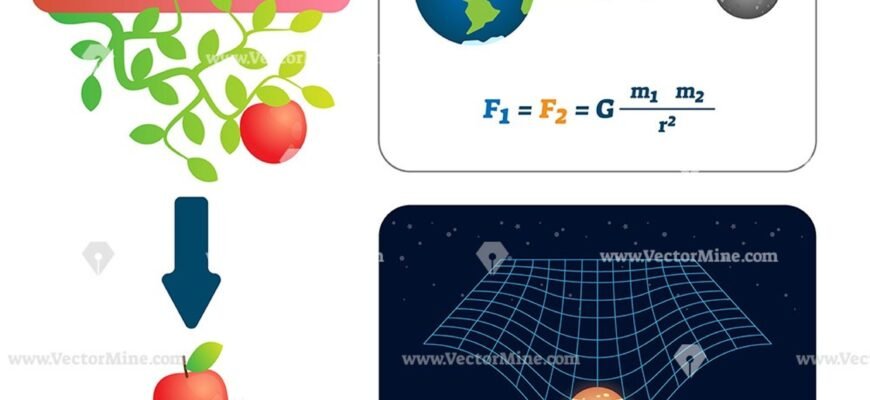
Gravity is an invisible force that attracts two bodies toward each other. It’s the reason why apples fall from trees and why planets orbit stars. This article will delve deep into understanding gravity, exploring its mechanisms, historical significance, and its pivotal role in shaping the universe.
What Is Gravity?
Gravity, the foremost of the four fundamental forces, governs the motion and structure of celestial bodies. But what is gravity at its core? In essence, gravity is a natural phenomenon whereby all things with mass or energy – including planets, stars, galaxies, and even light – are attracted to each other. The force of gravity is what keeps the planets in our solar system orbiting the Sun.
- Introduced by Sir Isaac Newton in the 17th century.
- Einstein provided a more precise explanation with his General Theory of Relativity.
- Essential for keeping water in our oceans and holding our atmosphere in place.
The Mechanism of Gravity: How Does It Work?
Gravity works through the curvature of space-time. When an object with mass exists, it causes the fabric of space-time to curve, and other objects move along these curves. This can be visualized as a heavy ball placed on a stretched rubber sheet, causing a dip that attracts smaller objects.
According to Newton’s Law of Gravitation, the gravitational force between two objects is directly proportional to the product of their masses and inversely proportional to the square of the distance between them.
The Historical Discovery of Gravity
The story of gravity began with Newton, who proposed that the same force pulling apples to the ground also held the Moon in orbit around Earth. His curiosity led to the formulation of the Universal Law of Gravitation. Later, Einstein’s insights expanded on Newton’s ideas by proposing that massive objects cause a deformation in space-time.
Applications of Gravity in Technology
Understanding gravity has profound implications in numerous fields:
- Aerospace: Calculation of satellite trajectories.
- Engineering: Structural integrity assessments under gravitational stresses.
- Medicine: Impact of gravity on human physiology in space travel.
The Role of Gravity in the Universe
Gravity is the architect that sculpts galaxies, stars, and planetary systems. Without gravity, the universe as we know it would not exist, as it brings matter together to form galaxies and governs the life cycles of stars.
Modern Research in Gravitational Physics
Scientists like Stephen Hawking have pushed the boundaries of understanding gravity. Recent efforts include the detection of gravitational waves, ripples in space-time caused by massive cosmic events.
| Aspect | Newton’s View | Einstein’s View |
|---|---|---|
| Gravitational Force | Action at a distance | Space-time curvature |
| Mathematical Framework | Force formula | Field equations |
| Examples | Falling apple | Light bending around stars |
Common Misconceptions About Gravity
Despite its fundamental nature, gravity often leads to misconceptions, such as:
- Gravity is the same everywhere – in reality, it varies depending on location and mass distribution.
- It acts instantly – changes in gravity propagate at the speed of light.
- It’s the only force acting on a falling object – air resistance also plays a role.
FAQ Section
What causes gravity?
Gravity is caused by the presence of mass in space-time, which leads to curvature of space-time that dictates the motion of objects.
How does gravity affect time?
According to Einstein’s theory, strong gravitational fields can slow down time, a phenomenon called time dilation.
Is it possible to create artificial gravity?
In theory, yes, artificial gravity can be created through centripetal force, using rotation to simulate gravitational pull.
Why are we drawn to Earth and not floating in space?
The Earth’s gravitational pull is strong due to its large mass, keeping us anchored to its surface.
What are gravitational waves?
Gravitational waves are ripples in space-time caused by energetic cosmic events, such as merging black holes.







