- Double Meaning of Words: Exploring the Depths of Ambiguity
- Introduction
- What Are Double Meanings?
- Types of Double Meaning Words
- How Double Meanings Impact Communication
- Using Double Meanings in Literature
- Common Mistakes with Double Meanings
- Practical Tips for Understanding Double Meanings
- Table of Common Double Meaning Words
- FAQs
- What is the importance of understanding double meanings?
- Which is better: homophones or homonyms?
- Can double meanings be humorous?
- Is it possible to learn all words with double meanings?
- What are common mistakes with double meanings?
Double Meaning of Words: Exploring the Depths of Ambiguity
Words can often have more than one meaning, leading to intriguing linguistic scenarios known as “double meanings.” These eccentric quirks of language not only enrich communication but also pose challenges and opportunities for wordplay, learning, and even misunderstandings. This comprehensive guide delves into the facets of double meanings of words, analyzing their implications, uses, and impact on communication.
Introduction
The English language is a complex tapestry of words, where many hold more than a single meaning. These double meanings, known as homonyms, polysemy, or homographs among linguistic experts, can transform ordinary conversation into a fertile ground for misunderstanding, humor, or depth. This article aims to examine these variations, from homophones to puns, and provide a practical guide to navigating the intriguing field of words with double meanings.
What Are Double Meanings?
Double meanings arise when a word has multiple interpretations. Homonyms, homographs, and homophones all contribute to the double meanings phenomenon, each having its nuances. Understanding these different types of words is crucial for mastering language nuances and enhancing communication.
Types of Double Meaning Words
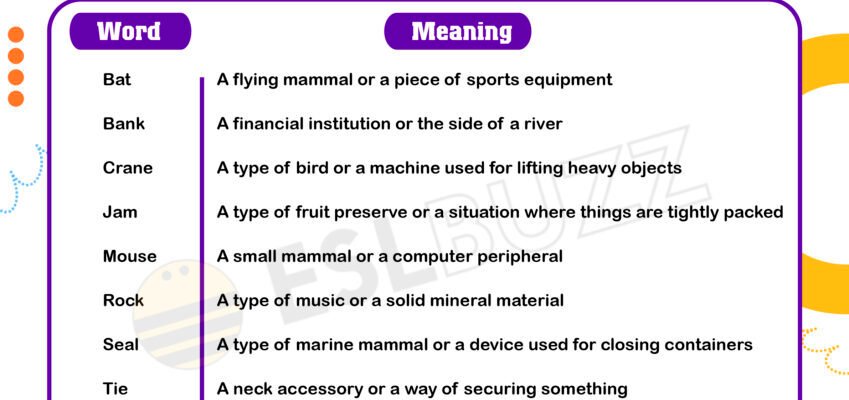
- Homonyms: Words that sound alike or have the same spelling but possess different meanings, for example, “bat” (the animal) and “bat” (the sports equipment).
- Homophones: Words that sound the same but have different meanings and often different spellings, such as “flower” and “flour.”
- Homographs: Words that have the same spelling but may not sound the same and have different meanings, like “lead” (to guide) and “lead” (a metal).
- Polysemy: A single word having multiple meanings that are related by extension, for instance, “mouth” as a part of a river and a human organ.
How Double Meanings Impact Communication
Double meanings are double-edged swords in communication. They can enhance dialogue by adding layers and depth or lead to confusion. Recognizing and interpreting these meanings correctly can be an asset to becoming an adept communicator.
Using Double Meanings in Literature
Authors and poets employ words with double meanings to enrich their text with deeper layers of meaning and symbolism. Shakespeare is a classic example, known for his wordplay that adds wit and complexity to his works.
Common Mistakes with Double Meanings
Misunderstanding double meanings can lead to common communication mistakes. This section highlights typical errors that arise through double meanings and offers ways to avert miscommunication.
- Assuming One Meaning: Assuming only one interpretation can lead to incomplete or incorrect understanding.
- Ignoring Context: Context is essential. Double meanings often rely heavily on surrounding words to clarify intent.
Practical Tips for Understanding Double Meanings
Learning to decode double meanings is a skill. Here are practical tips to hone that skill:
- Familiarize yourself with common homonyms, homophones, and homographs.
- When in doubt, ask for clarification.
- Emphasize context to unveil the intended meaning.
Table of Common Double Meaning Words
| Word | Meaning 1 | Meaning 2 |
|---|---|---|
| Bark | The sound a dog makes | The outer covering of a tree |
| Bow | A knot tied with loops | A gesture of bending forward |
| Seal | A marine animal | A closure with wax or other material |
FAQs
What is the importance of understanding double meanings?
Understanding double meanings is crucial for effective communication as it helps avoid misunderstandings and enriches language expression.
Which is better: homophones or homonyms?
Both homophones and homonyms have unique roles in language learning. Neither is better; they simply serve different purposes in communication and wordplay.
Can double meanings be humorous?
Yes, double meanings often serve as the basis for puns and jokes, adding humor and wit to language.
Is it possible to learn all words with double meanings?
While it’s challenging to learn all double meanings, familiarizing yourself with common examples can significantly improve understanding and communication.
What are common mistakes with double meanings?
Common mistakes include assuming a single meaning or ignoring contextual cues, leading to misinterpretation or confusion.







