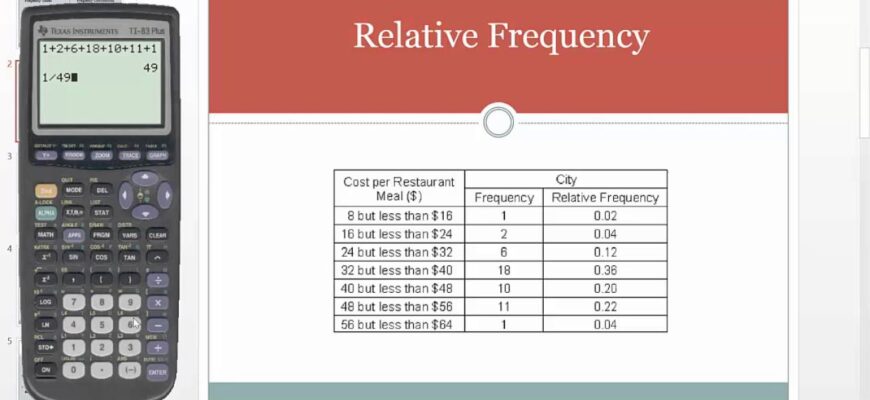
Relative frequency is how often a value occurs divided by the total number of observations.
Formula
Relative frequency = frequency of a value / total number of observations.
Steps
- Count how often each value appears.
- Count the total observations.
- Divide each count by the total.

Example
In a class of 20, 5 students chose blue. Relative frequency = 5 / 20 = 0.25, or 25 percent.


Check
All relative frequencies in a data set add up to 1 (or 100 percent). Cumulative relative frequency is the running total.
Based on data from standard introductory statistics texts.