- Understanding the Meaning of Affect Versus Effect
- Introduction
- What Is “Affect”?
- What Is “Effect”?
- Key Differences Between “Affect” and “Effect”
- Examples of How to Use “Affect” and “Effect” Correctly
- Common Mistakes and How to Avoid Them
- Which Is Better to Use?
- Is It Possible to Use “Affect” and “Effect” Interchangeably?
- How to Remember the Difference
- Frequently Asked Questions About “Affect” and “Effect”
Understanding the Meaning of Affect Versus Effect
Is it “affect” or “effect”? This common question puzzles many, leading to confusion even among native English speakers. With search queries like “affect vs effect grammar,” “difference between affect and effect,” and “how to use affect and effect,” this article aims to clarify these terms and ensure you use them correctly.
Introduction
The English language is filled with homophones, words that sound similar but have different meanings. “Affect” and “effect” are two such words that often cause confusion due to their similar sound and related meanings. Understanding how to properly use “affect” as a verb and “effect” as a noun can profoundly impact the effectiveness of your writing.
What Is “Affect”?
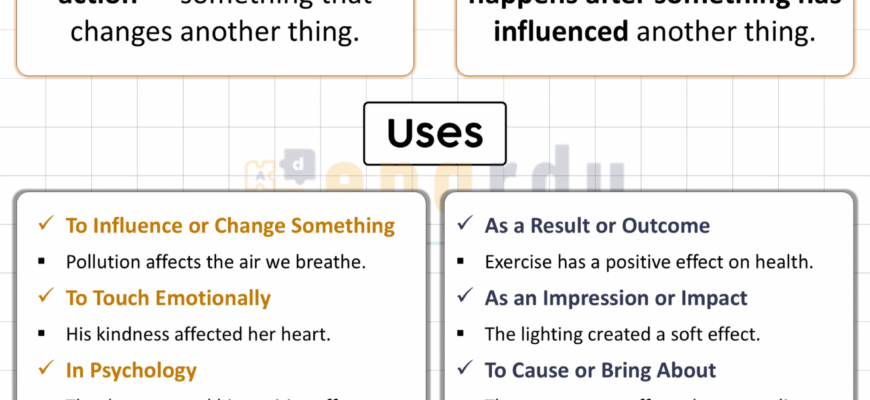
“Affect” is typically used as a verb, meaning to influence or make a difference to something. For example, “The weather can affect your mood.” Here, “affect” signifies the influence that weather can have on how you feel.
- Usage: Primarily as a verb.
- Example: “The new law will affect the economy.”
What Is “Effect”?
“Effect” is most often used as a noun and refers to the result or outcome of a change. For instance, “The effect of the new law on the economy was significant.” In this context, “effect” denotes the result of the law being enforced.
- Usage: Primarily as a noun.
- Example: “The medication had an immediate effect.”
Key Differences Between “Affect” and “Effect”
While “affect” is a verb and “effect” is a noun, there are exceptions and special cases that add layers of complexity. For instance, in psychology, “affect” can be a noun referring to an observable expression of emotion. Grasping these nuances can make your writing more precise and impactful.
| Word | Type | Common Usage | Example Sentence |
|---|---|---|---|
| Affect | Verb | Influences something | “The news may affect her decision.” |
| Effect | Noun | Result of a change | “The effect of pollution is alarming.” |
Examples of How to Use “Affect” and “Effect” Correctly
- “His attitude can affect the team’s performance.”
- “We noticed a positive effect on productivity after the policy change.”
- “Weather affects my mood greatly.”
- “The therapy had a great effect on her health.”
Common Mistakes and How to Avoid Them
One common mistake is using “affect” and “effect” interchangeably. Remember, if you’re describing an action, it’s usually “affect.” If you’re describing the outcome, it’s “effect.” Many also make the error of thinking “effect” can always serve as a verb. An easy mnemonic: “Affect” verb; “Effect” gets.
Which Is Better to Use?
The choice between “affect” and “effect” isn’t about one being better; rather, it’s about choosing the correct word to convey your message effectively. Misusing these words can reduce clarity, so understanding when to use each is crucial.
Is It Possible to Use “Affect” and “Effect” Interchangeably?
While some may think these words are interchangeable due to their phonetic similarity, they are not. Their interchangeability is only valid in specific contexts, such as in medical or psychological jargon, which often requires specialized usage.
How to Remember the Difference
To remember the difference, associate “Affect” with “Action” since both start with ‘A’. Similarly, link “Effect” with “End result” as both start with ‘E’. Leveraging these mnemonic devices can help you to avoid confusion in your communication.
Frequently Asked Questions About “Affect” and “Effect”
- What is the main difference between affect and effect?
“Affect” is a verb meaning to influence, while “Effect” is a noun denoting the result of an influence. - Can “affect” ever be a noun?
Yes, in psychology, “affect” as a noun refers to an observable expression of emotion. - Is “effect” ever used as a verb?
Rarely, “effect” can be a verb meaning to bring about, as in “to effect a change.” - How do I choose between affect and effect in a sentence?
Determine if the word is describing an action (“affect”) or the outcome (“effect”). - Can both “affect” and “effect” be correct in a sentence?
Yes, depending on context, both can appear correctly in the same sentence: “The heat affects me differently, but the effect is the same across the board.”







