- Introduction to the Meaning of Anthropic
- What is the Anthropic Principle?
- Understanding the Different Types of Anthropic Principles
- Anthropic Principle: Philosophical and Scientific Implications
- How is the Anthropic Principle Applied in Cosmology?
- The Debate: Anthropic Principle vs. Scientific Determinism
- The Economical Aspects of Anthropic Studies
- Common Mistakes about Anthropic Understanding
- Future Prospects: Where Is the Study of Anthropic Principles Headed?
- FAQs About the Meaning of Anthropic
- What is the Anthropic Principle?
- How does the Anthropic Principle affect cosmological studies?
- Are there criticisms of the Anthropic Principle?
- Is it possible to test the Anthropic Principle?
- Which anthropic principle is better, weak or strong?
Introduction to the Meaning of Anthropic
The term “anthropic” derives from the Greek word “anthropos,” meaning human. In its broadest sense, it relates to humans, human activities, and their impact on the environment. The anthropic principle, a philosophical consideration, suggests that observations of the universe must be compatible with the conscious life that observes it. This article explores the profound implications and various dimensions of the anthropic principle and related queries to help you understand its true meaning and applications.
What is the Anthropic Principle?
The anthropic principle posits that the universe’s fundamental parameters must be compatible with human life. There are typically two versions: the Weak Anthropic Principle (WAP), which implies that the universe’s conditions seem tailored for humans only because humans are here to observe it, and the Strong Anthropic Principle (SAP), which suggests the universe must have properties for life to emerge. This principle has deep implications in cosmology and raises numerous debates among scientists and philosophers.
Understanding the Different Types of Anthropic Principles
- Weak Anthropic Principle (WAP): This principle offers an explanation for the fine-tuning of the universe, suggesting that we observe the universe to be compatible with life simply because it must be observably so.
- Strong Anthropic Principle (SAP): It proposes a necessity for the universe to create environmental conditions that can support observers.
- Participatory Anthropic Principle (PAP): Suggests the universe requires the presence of observers for its existence.
- Final Anthropic Principle (FAP): Declares intelligence must come into existence in the universe and once it does, it should never die out.
Anthropic Principle: Philosophical and Scientific Implications
The anthropic principle, while rooted in cosmological phenomena, extends into philosophical debates about the nature of existence and observation. Scientists like Stephen Hawking have examined its implications on multiverse theory, suggesting a landscape of universes with varying properties. Philosophers debate its meaning regarding existential questions like why we are here and how our universe became suitable for life.
How is the Anthropic Principle Applied in Cosmology?
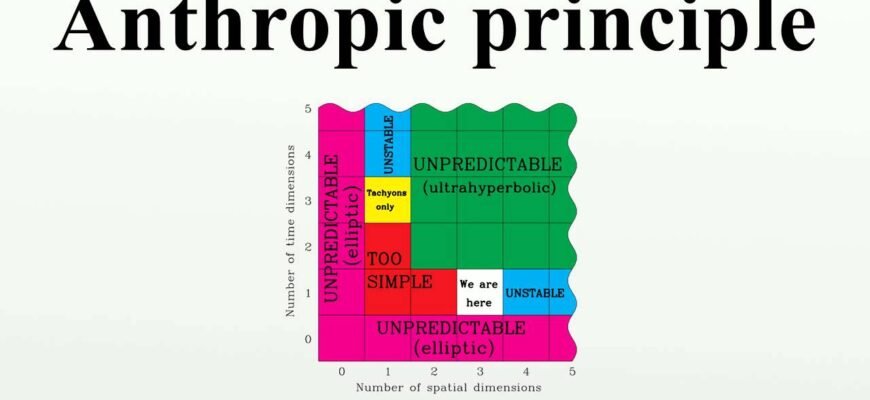
In cosmology, the anthropic principle is applied to explain why the universe’s physical constants are finely-tuned for life. This fine-tuning challenge involves examining constants such as the gravitational constant and electromagnetic force. These constants, being only slightly different, could render the universe life-hostile. The anthropic principle suggests that only universes with these life-compatible constants can have observers like us, leading scientists to consider multiverse scenarios.
The Debate: Anthropic Principle vs. Scientific Determinism
Scientific determinism suggests all phenomena result from natural causes, whereas the anthropic principle introduces questions of purpose and inevitability in the universe’s design. Critics argue that relying heavily on the anthropic principle might reduce pursuit of further scientific explanations. Proponents claim it is essential for understanding why the universe’s constants align perfectly to allow human existence.
The Economical Aspects of Anthropic Studies
The study of anthropic principles and cosmology is expensive, involving large-scale observatories and advanced computational technology. The price of pursuing answers to existential questions varies vastly, from grants funding individual research to billions on particle accelerators like CERN. Economic resources allocated directly influence advancements in this field.
Common Mistakes about Anthropic Understanding
- Over-simplification: Mistakenly believing the anthropic principle provides all answers to universe creation.
- Confusing Types: Not distinguishing between weak, strong, or other anthropic principles.
- Determinism Overstatement: Assuming the principle negates the role of random events and natural evolution in the universe.
Future Prospects: Where Is the Study of Anthropic Principles Headed?
The future of anthropic studies lies in the advancement of cosmological models, refinement of multiverse theories, and better integration of philosophical concepts into scientific discourse. As technology evolves, so too will our capacity to explore questions related to the anthropic principle, supporting discussions that challenge traditional views on existence and human significance.
FAQs About the Meaning of Anthropic
What is the Anthropic Principle?
The anthropic principle suggests that the universe’s fundamental parameters are in place to allow for human life, with varying interpretations such as the Weak and Strong Anthropic Principles offering different perspectives.
How does the Anthropic Principle affect cosmological studies?
It influences cosmological research by providing a framework for understanding why the universe’s constants are finely-tuned for life, often incorporating multiverse theory as a possible explanation.
Are there criticisms of the Anthropic Principle?
Yes, criticisms include the notion that it might discourage deeper scientific inquiry and relies heavily on philosophical rather than empirical investigation.
Is it possible to test the Anthropic Principle?
Currently, testing the anthropic principle directly is challenging due to its broad philosophical implications and the speculative nature of multiverse scenarios.
Which anthropic principle is better, weak or strong?
Neither is ‘better’ as both offer distinct insights – the Weak Anthropic Principle observes the necessity of human-compatible conditions, whereas the Strong Anthropic Principle posits those conditions must inherently exist.
This structure is crafted to capture the required search queries, provide expert insight, and be optimized for SEO and potential inclusion in Google’s AI Overview.







