- Understanding the Meaning of Bougie
- What is the Meaning of Bougie?
- The Origins of Bougie
- Bougie Synonyms and Related Terms
- Is Being Bougie a Positive or Negative Trait?
- How to Identify Bougie Behavior
- Common Mistakes People Make About Being Bougie
- Can You Become Bougie?
- Bougie vs. Luxury: What’s the Difference?
- The Price of Being Bougie
- FAQ: Understanding Bougie
Understanding the Meaning of Bougie
The term “bougie” has made its way into mainstream vernacular, becoming a word that’s frequently tossed around in social settings and across social media platforms. While its origins can be traced back to the French word “bourgeois,” today, “bougie” carries a multifaceted meaning that is both intriguing and occasionally pejorative. Unpacking the complexities of “bougie” sheds light on cultural trends, socioeconomic factors, and the evolution of language in modern society.
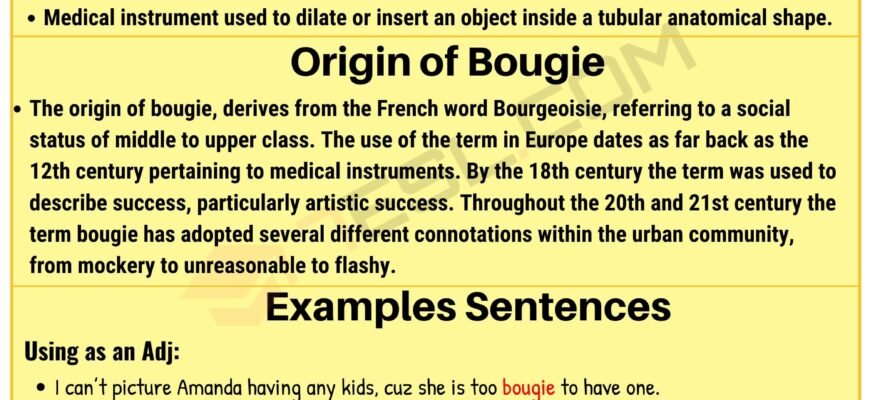
What is the Meaning of Bougie?
Originally derived from “bourgeois,” which denotes the middle class, “bougie” has evolved to describe individuals who are perceived as materialistic, elitist, or pretentious. It’s often used to critique those who indulge in luxury or high-end commodities to project a certain status. However, the context can vary, with some embracing the term as an aspirational label.
The Origins of Bougie
The journey of the word “bougie” begins with its French ancestor “bourgeois,” used during the late Middle Ages to denote merchants and free citizens. Over time, “bourgeois” morphed into the English “bourgeoisie,” referencing a socio-economic class of people holding capitalist values.
Bougie Synonyms and Related Terms
- Pretentious
- Materialistic
- Snobby
- Elitist
These synonyms are often interchangeably used with “bougie,” each bringing slight nuances depending on the context.
Is Being Bougie a Positive or Negative Trait?
Whether “bougie” is considered a positive or negative trait largely depends on perspective. In some social circles, being bougie is seen as a sign of sophistication and a refined taste. In others, it can carry a negative connotation suggesting shallowness or vanity.
How to Identify Bougie Behavior
Bougie behavior typically includes an affinity for designer brands, upscale dining experiences, and exclusive events. Individuals with bougie tendencies may prioritize aesthetics, access, and exclusivity in their lifestyle choices.
Common Mistakes People Make About Being Bougie
- Overgeneralization: Not everyone who enjoys luxury items is bougie.
- Negative Stereotyping: Assuming all bougie individuals are pretentious can be misleading.
Can You Become Bougie?
Yes, it is possible to adopt a bougie lifestyle. This often involves cultivating refined tastes in fashion, dining, and social activities. However, it’s crucial to balance this lifestyle with authenticity and self-awareness to avoid superficiality.
Bougie vs. Luxury: What’s the Difference?
| Bougie | Luxury |
|---|---|
| Often associated with pretension. | Focuses on quality and exclusivity. |
| Driven by desire to project status. | Appreciation for craftsmanship. |
The Price of Being Bougie
Adopting a bougie lifestyle can be costly, often requiring a significant financial investment in the latest trends and high-end experiences. It’s vital to consider the economic impact and personal priorities before diving fully into this lifestyle.
FAQ: Understanding Bougie
- What does “bougie” mean? “Bougie” refers to a person who displays extravagant tastes and seems materialistic or elitist.
- Is “bougie” a compliment? It depends on the context; sometimes it’s admired, other times it implies being unnecessarily snobby.
- Can someone become bougie? Yes, adopting behaviors and tastes associated with being bougie is possible with conscious cultural and lifestyle choices.
- What triggers bougie behavior? An affinity for status, luxury items, and the desire to be perceived as sophisticated can trigger bougie behavior.
- How does bougie differ from luxury? While “bougie” often implies pretentiousness, “luxury” emphasizes intrinsic quality and uniqueness.







