- Understanding the Meaning of Reverberate
- What Does “Reverberate” Mean?
- How Does Reverberation Occur in Acoustics?
- Key Factors Affecting Reverberation
- Applications of Reverberate in Various Fields
- Comparing Reverberate with Echo
- Common Mistakes in Understanding Reverberate
- Is It Possible to Control Reverberation?
- Reverberation’s Role in Music Production
- Is Reverberate Always Negative?
- Frequently Asked Questions about Reverberate
Understanding the Meaning of Reverberate
Reverberate is a term often encountered in discussions about sound, acoustics, and its metaphorical applications in various fields. In this article, we aim to delve deep into the multifaceted meanings of “reverberate,” explore its usage, and answer popular search queries. Our goal is to ensure readers leave with a comprehensive understanding of the word and insights into its practical implications.
What Does “Reverberate” Mean?
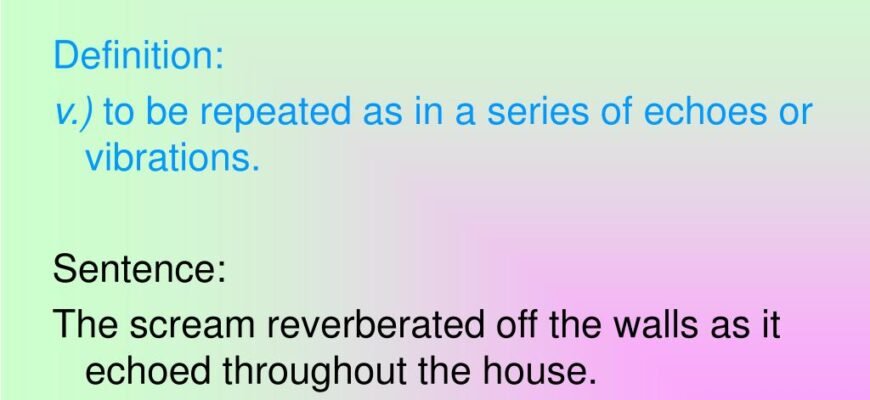
The term “reverberate” fundamentally refers to the continuation or echoing of a sound. However, its applications are not restricted to auditory contexts alone. It can also describe the impact or influence of events, actions, or decisions that seem to resonate or persist over time.
- Sound Reverberation: In an acoustic sense, reverberation occurs when sound waves reflect off surfaces, creating a prolongation of sound.
- Metaphorical Reverberation: It can also refer to the ripple effects an event or situation has on people or situations, akin to an echo in non-auditory contexts.
How Does Reverberation Occur in Acoustics?
Acoustic reverberation happens when sound waves bounce off surfaces like walls, ceilings, and floors, resulting in a series of reflections that gradually diminish. The design and material of a space significantly influence the amount and quality of reverberation.
Key Factors Affecting Reverberation
- Room Size: Larger rooms tend to have more reverberation due to the increased distance sound waves must travel.
- Surface Materials: Hard, flat surfaces reflect sound more efficiently compared to soft, uneven surfaces.
- Room Shape: Irregularly shaped rooms may cause uneven distribution of sound reflections.
Applications of Reverberate in Various Fields
Beyond acoustics, “reverberate” finds applications in numerous fields such as psychology, business, and literature. Each application emphasizes the persistent impact of an event or idea.
For example, in the business realm, a decision by a major corporation can “reverberate” throughout the stock market, affecting global financial conditions.
Comparing Reverberate with Echo
| Feature | Reverberate | Echo |
|---|---|---|
| Duration | Prolonged and complex | Distinct and singular |
| Acoustic Environment | Occurs in enclosed spaces with many reflective surfaces | Occurs in open spaces with few reflective surfaces |
| Perception | Produces a continuous, overlapping sound | Produces distinct repetitions |
Common Mistakes in Understanding Reverberate
Many people confuse reverberation with echo, though there are notable differences between the two. Reverberation is more about the persistence and diffuse nature of sound, while echo specifically refers to distinct repetitions of sound.
Is It Possible to Control Reverberation?
Controlling reverberation involves modifying the acoustic environment. This can be achieved through the use of sound-absorbing materials such as carpets, curtains, and acoustic panels that reduce sound reflections.
Reverberation’s Role in Music Production
Reverberation plays a critical role in music and audio production, where it is intentionally used to enhance sound quality and add depth and ambiance to recordings.
Is Reverberate Always Negative?
Not necessarily. While excessive reverberation might be undesirable in certain settings, such as office spaces or classrooms, it enhances the auditory experience in concert halls and similar venues.
Frequently Asked Questions about Reverberate
- What is the meaning of reverberate? Reverberate means the prolongation or echoing of sound, but it can also extend to describe the extended impact of events or decisions.
- How does reverberation occur? Reverberation occurs when sound waves reflect off surfaces within an enclosed space, causing a prolongation of sound.
- What is the difference between echo and reverberate? An echo is a clear and distinct repetition of sound, while reverberation involves a more complex and prolonged series of overlapping reflections.
- How can I reduce reverberation in my home? You can reduce reverberation by using soft furnishings, such as carpets and curtains, and installing acoustic panels to absorb sound reflections.
- What is acoustic treatment? Acoustic treatment involves modifying a space to optimize sound quality by controlling reflections, echoes, and reverberation.







