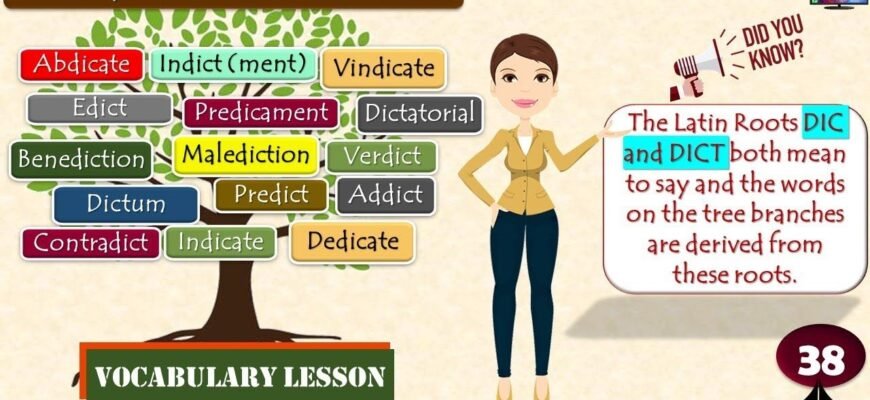
- Understanding the Root Meaning of “Dict”
- The Origin and Definition of “Dict”
- Common Words with “Dict” Root and Their Meanings
- Understanding “Dict” in Context: Language and Communication
- Applications of “Dict” in Different Fields
- Table of Common Words with “Dict” and Their Usage
- Which Is Better: Paper Dictionary or Digital Dictation?
- Frequently Asked Questions About the “Dict” Root
- What is the Latin root “dict”?
- How is “dict” used in everyday English?
- Can you give an example of a “dict” word in technology?
- Why is understanding word roots helpful in learning English?
- Are there any mistakes people commonly make with “dict” words?
Understanding the Root Meaning of “Dict”
Language is a living entity, evolving constantly with new words and meanings. At the heart of many complex words lies a root that provides foundational meaning. One such intriguing root is “dict.” Derived from Latin, this root has birthed a plethora of words in English. In this article, we’ll embark on an insightful journey to explore the root meaning of “dict,” its origins, applications, and impact on the English language.
The Origin and Definition of “Dict”
The root “dict” is derived from the Latin word “dicere,” which means “to say” or “to speak.” This root forms the basis for numerous words in the English language that revolve around the concepts of speaking, saying, or proclaiming.
Common Words with “Dict” Root and Their Meanings
Understanding words formed from a single root can enhance vocabulary and comprehension across a spectrum of disciplines. Here are some notable words that stem from the root “dict”:
- Dictionary: A reference book containing an alphabetical list of words with information about them.
- Dictate: To say or read aloud words for someone else to write down or to issue a command.
- Predict: To say what will happen before it takes place.
- Contradict: To speak against or state the opposite.
- Verdict: A decision or judgment, often provided by a jury, in a court of law.
Understanding “Dict” in Context: Language and Communication
The root “dict” appears predominantly in contexts related to language and communication. Its significance is evident in linguistic development, where expression, assertion, and communication are fundamental.
Applications of “Dict” in Different Fields
The influence of the “dict” root extends beyond basic communication. Here are some fields where words with “dict” are frequently encountered:
- Legal: Words like “verdict” and “edict” play crucial roles in legal contexts.
- Technology: In programming and AI, dict can refer to a dictionary data structure where keys “say” what values they hold.
- Education: Dictionaries and dictation exercises are fundamental tools for language learners.
Table of Common Words with “Dict” and Their Usage
| Word | Meaning | Usage |
|---|---|---|
| Dictionary | A reference book | He used a dictionary to find the meaning of words. |
| Dictate | Lay down authoritatively | The boss dictates the terms of employment. |
| Predict | Say something will happen | Weather forecasts predict rain for tomorrow. |
| Contradict | Deny directly | Her testimony contradicts the previous witness. |
Which Is Better: Paper Dictionary or Digital Dictation?
Many people wonder which tool is superior – a traditional paper dictionary or modern digital dictation? Both have their merits. Paper dictionaries are invaluable for in-depth study, providing extensive word origins and nuanced meanings. On the other hand, digital dictation offers convenience and quick access to thousands of words, perfect for on-the-go learning. The choice largely depends on individual preferences and specific needs.
Frequently Asked Questions About the “Dict” Root
What is the Latin root “dict”?
Derived from “dicere,” meaning “to say” or “to speak,” the Latin root forms the foundation of numerous English words related to expression and communication.
How is “dict” used in everyday English?
Words like “dictate,” “predict,” and “contradict” are common in everyday English, each relating to speaking, declaring, or asserting something.
Can you give an example of a “dict” word in technology?
In technology, the word “dict” refers to a dictionary object, a data structure that pairs keys with values, akin to a spoken pairing of meanings and words.
Why is understanding word roots helpful in learning English?
Understanding word roots enhances vocabulary, aids comprehension, and helps decipher unfamiliar words by revealing their inherent meanings.
Are there any mistakes people commonly make with “dict” words?
A common mistake is confusing the pronunciation and spelling of “dict” words, such as “predict” often being misspelled as “pridict.”







