- Understanding the Meaning of Far Right
- What is the Far Right?
- Historical Origins of the Far Right
- Key Characteristics of Far-Right Ideologies
- Comparing Far Right and Far Left
- Impact of Far-Right Movements
- Common Misunderstandings about the Far Right
- Global Presence of the Far Right
- How is the Far Right Perceived Today?
- Is There a Future for the Far Right?
- FAQ Block
- What is the far right?
- How does far right differ from far left?
- What are common characteristics of the far right?
- How has the far right impacted global politics?
- Is the far right growing in influence?
Understanding the Meaning of Far Right
The term “far right” is often referenced in political discourse, yet it can be somewhat ambiguous due to its varying interpretations across different contexts. This article aims to explore the full scope of what “far right” means, including its historical origins, key characteristics, and how it compares to other political ideologies.
What is the Far Right?
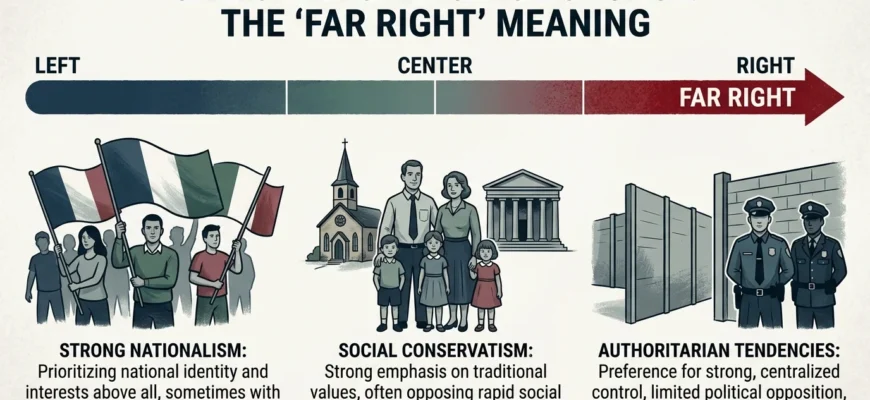
The far right generally refers to political groups or individuals whose views are significantly more conservative or reactionary than the mainstream right-wing positions. These ideologies often emphasize nationalism, nativism, and a strong inclination towards preserving traditions and social hierarchy.
Historical Origins of the Far Right
Historically, the far right emerged as a response to various forms of social change and upheaval. This section will delve into its origins, tracing back to movements like monarchism and fascism. Key events, such as the rise of Nazism in Germany, offer a historical perspective on how far-right ideologies gained traction.
Key Characteristics of Far-Right Ideologies
Far-right movements often advocate for authoritarianism, ultra-nationalism, and opposition to immigration. This section details these characteristics, comparing them with moderate right-wing ideologies to highlight their distinct nature.
- Nationalism: Intense pride in one’s nation, often accompanied by an exclusionary view towards others.
- Traditionalism: A commitment to maintaining established social norms and hierarchies.
- Misoneism: Aversion to innovation and progressive social change.
Comparing Far Right and Far Left
While often juxtaposed as polar opposites, far-right and far-left ideologies can sometimes overlap in their authoritarian approaches. This section will compare their core beliefs, exploring both the differences and similarities present in their political strategies and objectives.
Impact of Far-Right Movements
Far-right movements have left a significant impact on global politics, from influencing policy to shaping electoral outcomes. This part of the article will examine specific case studies where far-right ideologies have markedly altered the political landscape.
Common Misunderstandings about the Far Right
There are numerous misconceptions about what constitutes the far right. This section will clarify common myths, providing a balanced view that aids in distinguishing these ideologies from other conservative movements.
Global Presence of the Far Right
Far-right ideologies are not confined to any one region. This section highlights the presence of such movements across different continents, noting cultural variations and local adaptations.
| Region | Prominent Far-Right Movement |
|---|---|
| Europe | National Front (France) |
| North America | Alt-Right (United States) |
| Asia | Hindu Nationalism (India) |
How is the Far Right Perceived Today?
Contemporary views on far-right movements vary significantly, from those who see them as a legitimate expression of cultural and nationalist pride to those who view them as a threat to social cohesion. This section aims to explore current public perceptions and media portrayals of the far right.
Is There a Future for the Far Right?
The concluding section examines the potential future trajectories for far-right movements. With growing political polarization in many countries, it’s worth exploring whether far-right ideologies will continue to gain prominence.
FAQ Block
What is the far right?
The far right refers to political groups or individuals with extreme conservative views, often emphasizing nationalism and traditionalism.
How does far right differ from far left?
While both can be authoritarian, far-right ideologies focus on nationalism and preservation of tradition, whereas far-left ideologies emphasize egalitarianism and socialism.
What are common characteristics of the far right?
Common characteristics include nationalism, traditionalism, and opposition to immigration and multiculturalism.
How has the far right impacted global politics?
Far-right movements have influenced policies, elections, and social discourse in various countries by advocating for national sovereignty and conservative values.
Is the far right growing in influence?
In some countries, far-right movements are gaining traction due to increased political polarization and public dissatisfaction with traditional parties.







