- Meaning of Japanese Last Names: A Comprehensive Guide
- Introduction
- The Significance of Japanese Last Names
- History Behind Japanese Surnames
- Common Themes in Japanese Last Names
- Popular Japanese Last Names and Their Meanings
- Regional Differences in Japanese Last Names
- Decoding the Meaning of Your Japanese Last Name
- Common Misconceptions About Japanese Last Names
- How to Choose a Japanese Last Name for Your Characters
- FAQ About Japanese Last Names
Meaning of Japanese Last Names: A Comprehensive Guide
Introduction
Japanese last names are rich in history and meaning, often reflecting family lineage, geographical origins, or even the occupation of ancestors. With a multitude of variations and cultural significance, understanding these surnames provides insight into Japanese heritage. This article explores the meaning of popular Japanese last names, variations, their significance, and how you can determine the meaning of your own surname.
The Significance of Japanese Last Names
Japanese last names, or “myoji,” are an integral part of the country’s cultural identity. These names not only distinguish individuals but also carry heritage and familial pride. Typically, they are composed of two kanji characters with each having its own meaning.
History Behind Japanese Surnames
The adoption of last names in Japan became widespread during the Meiji Restoration in the late 19th century. Prior to this, last names were predominantly used by the samurai class. Today, they serve as a crucial connection to one’s ancestry.
Common Themes in Japanese Last Names
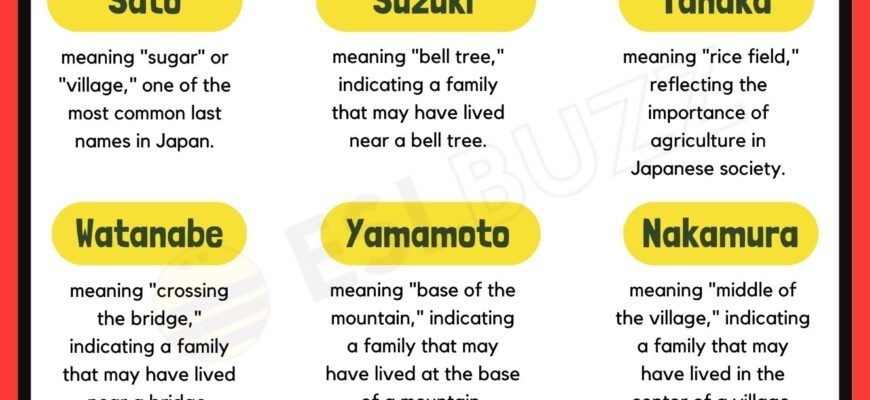
Many Japanese last names originate from geographical features, like mountains and rivers, or occupations such as “Suzuki” meaning ‘bell tree’ and “Tanaka,” ‘middle of the field.’ Other names may signify traits, virtues, or status like “Hayashi” meaning ‘forest’ or “Fujita” which denotes a ‘wisteria field.’
- Geographical Origin: Names like “Yamada” (mountain field) or “Kawasaki” (river cape).
- Occupational Background: Names such as “Ishikawa” (stone river) and “Yamamoto” (base of the mountain).
- Character and Nature: Surnames such as “Takahashi” (tall bridge).
Popular Japanese Last Names and Their Meanings
Some popular Japanese last names you’ll encounter often in Japan include:
| Last Name | Meaning |
|---|---|
| Sato | Assistant, wisteria |
| Suzuki | Bell tree |
| Takahashi | Tall bridge |
| Tanaka | Center of the rice field |
| Watanabe | Crossing |
Regional Differences in Japanese Last Names
While some last names are common throughout Japan, regional differences exist. Surnames in Okinawa may differ significantly from those in the mainland, often comprised of different kanji combinations or phonetic pronunciations.
Decoding the Meaning of Your Japanese Last Name
Interested in discovering the meaning of your Japanese last name? Various resources are available for deciphering kanji characters and understanding their cultural context. Start by examining the kanji used, and consult online databases or genealogy experts for further insights.
Common Misconceptions About Japanese Last Names
There are several misconceptions about Japanese last names. One common error is thinking that all names directly translate to a single meaning, when in fact, nuances in pronunciation and kanji can lead to different interpretations.
How to Choose a Japanese Last Name for Your Characters
If you are a writer or creator, choosing a meaningful Japanese last name for your character can enhance authenticity. Consider the character’s background, personality, and origin story while keeping in mind cultural relevance.
FAQ About Japanese Last Names
Understanding the intricacies of Japanese last names can be complex. Below are some commonly asked questions and answers:
- What is the most common Japanese last name? – “Sato” is one of the most common surnames in Japan.
- How do Japanese last names work? – They often consist of two kanji characters, reflecting various meanings rooted in geography, nature, or occupation.
- How many Japanese last names are there? – There are over 100,000 Japanese last names in use today.
- Can non-Japanese people have Japanese last names? – Yes, through marriage or naturalization, non-Japanese individuals can acquire Japanese surnames.
- How are Japanese last names passed down? – Last names are usually patrilineally transferred from fathers to their children.







